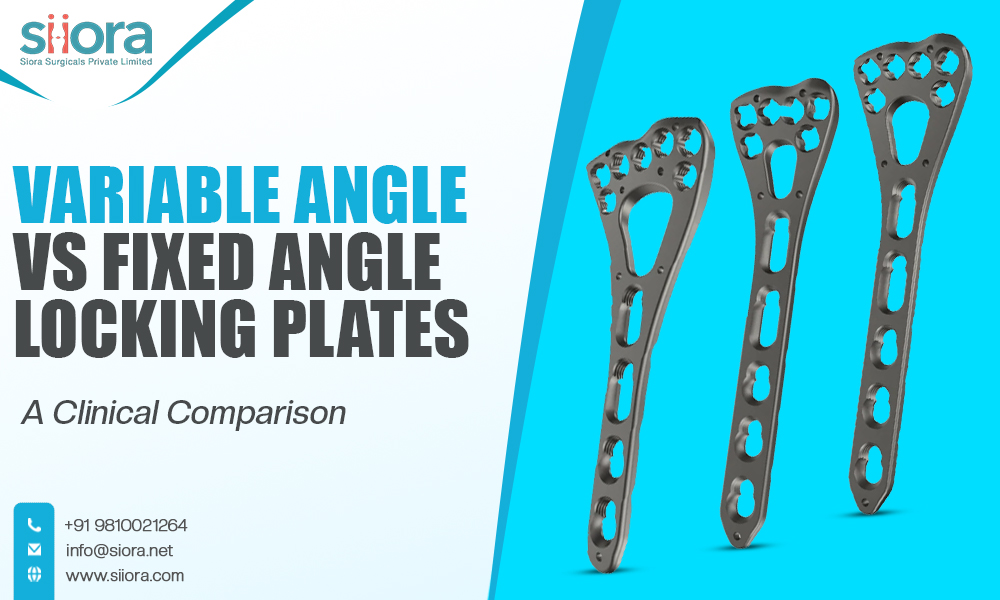
Locking plate technology changed orthopedic trauma care by offering rigid fixation for complex fractures—especially around joints and in osteoporotic bone. Over time, two main styles have evolved: fixed angle locking plates (FALPs) and variable angle locking plates (VALPs). While both secure screws to the plate to create a stable construct, their mechanics—and clinical results—differ in subtle but important ways. Understanding how they compare helps surgeons pick the right implant for each fracture pattern.
The Basics: How Each System Works
Fixed angle plates have threaded holes that allow screws to lock only at one predetermined direction. Once the screw head engages, the bone and plate form a fixed-angle construct, resisting motion in any plane. This stability is great for simple fractures or those where precision angles are easy to achieve.
Variable angle plates, in contrast, give surgeons flexibility. Each screw hole features a conical design, usually allowing 15°–30° of angular freedom within which a screw can still lock into the plate’s threads. This adaptability makes VALPs a smarter choice in anatomically complex areas or multi-fragmentary fractures where no single screw trajectory fits all.
Clinically, both aim to give the same thing: a solid “internal frame” that supports bone healing while minimizing soft tissue disruption.
Intraoperative Flexibility
Flexibility is where VALPs stand out. In real surgery, fractures rarely line up perfectly. Bone density varies, fragments rotate, and the perfect fixed screw line may miss healthy bone. Surgeons using fixed angle plates sometimes struggle when a screw path intersects a void, joint surface, or implant—forcing them to reposition the plate or pick a smaller screw.
Variable angle plates solve this by letting the surgeon choose the route. Screws can be angled to reach the best possible bone stock or avoid tendons and neurovascular structures. This is especially useful in periarticular sites like the distal radius, tibial plateau, and proximal humerus, where joint congruity and screw trajectory precision are crucial.
In studies and operating room experience, VALPs are associated with shorter operative times and fewer hardware adjustments because of this real-time adaptability.
Stability and Biomechanics
At first glance, it might seem logical that adjustable screw directions could reduce mechanical strength. However, biomechanical testing shows that modern VALP systems maintain nearly identical torsional and axial stiffness compared to FALPs. The key is the engineered “cone-locking” interface—they still create a fixed-angle construct, just with freedom before locking.
In unstable or osteoporotic fractures, both systems distribute load efficiently and resist collapse. Some studies even suggest that VALPs provide slightly better subchondral support because they can capture multiple bone fragments in denser trabecular zones, improving pull-out strength and reducing risk of fixation failure.
Meanwhile, fixed angle plates still excel in straightforward diaphyseal fractures or cases where linear trajectories suffice. Their simpler design reduces cost and offers dependable results without the added complexity.
Clinical Outcomes and Union Rates
Clinically, both designs show high union rates—routinely above 90% in most large series. Differences show up more in complication rates and functional outcomes for complex fractures.
VALPs demonstrate lower rates of screw loosening, secondary displacement, and malalignment in comminuted or periarticular fractures. Patients often achieve faster range-of-motion recovery because implant stability better maintains alignment during early rehab.
However, fixed angle plates still perform equally well in simple settings. For transverse or short oblique shaft fractures, their predictability and durability can’t be beaten. In cost-sensitive healthcare systems, they remain a mainstay for routine trauma cases.
Learning Curve and Cost
From a practical standpoint, variable angle plates demand slightly more surgical precision. Angling screws off-axis within the safe cone requires attention to detail to avoid cross-threading or over-angulation that can weaken the lock. Most modern targeting guides simplify this, but training still matters.
Cost is another point: VALPs can be 20–30% more expensive than FALPs. Yet, with fewer revisions and quicker restorations of function in tough fractures, the overall value evens out in the long run.
The Bottom Line
When comparing variable angle vs fixed angle locking plates, the choice boils down to anatomy and fracture complexity.
- Go fixed angle for simple, aligned fractures where cost, speed, and proven stability are priorities.
- Choose variable angle when dealing with periarticular, comminuted, or osteoporotic fractures requiring precision screw targeting and contour adaptability.
Both technologies have improved outcomes dramatically; they just serve different surgical realities. In the end, the best orthopedic implant plate isn’t simply the most advanced—it’s the one that aligns with the fracture, the bone, and the surgeon’s skill.
 Siora Surgicals Pvt. Ltd.